Are Baby Loungers Safe for Newborns?
*We may earn a commission for purchases made using our links. Please see our disclosure to learn more.
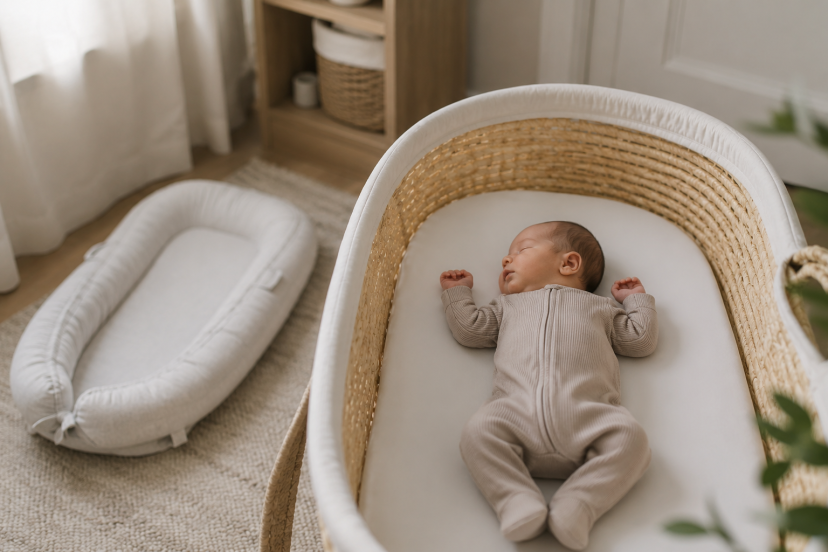
Baby loungers are popular because they create a cozy, contained place where parents can set their newborn down while staying nearby. Most have a padded center surrounded by raised, pillow-like sides and may be described as nests, pods, docks, positioners, or infant support cushions.
However, the comforting appearance of a baby lounger can create a dangerous misunderstanding: baby loungers are not safe places for newborns to sleep. Their soft padding, curved sides, and sloped surfaces can obstruct a baby’s breathing, contribute to positional asphyxia, or trap an infant who turns toward the side.
A newborn should sleep only on their back in a safety-approved crib, bassinet, bedside sleeper, portable crib, or play yard with a firm, flat surface and a fitted sheet. The sleep space should contain no pillows, blankets, toys, positioners, or padded loungers. These recommendations apply to naps as well as overnight sleep.
“Infant loungers … are not safe for sleep.”
— HealthyChildren.org, American Academy of Pediatrics
Key Takeaways
- Baby loungers should never be used for naps or overnight sleep, even when an adult is watching.
- If a newborn falls asleep in a lounger, move them immediately to a firm, flat, approved sleep space.
- Soft padding and raised sides can create suffocation, entrapment, rolling, and positional-asphyxia hazards.
- Placing a lounger inside a crib, bassinet, play yard, adult bed, or other sleep space does not make it safer.
- A flat play mat is generally a better choice for supervised awake time.
- Check the Consumer Product Safety Commission recall database before buying or using any infant lounger, especially a secondhand product.
- Cribs, bassinets, portable play yards, and approved bedside sleepers are better choices when a baby may fall asleep.
Four Safer Alternatives to Baby Loungers
The best alternative depends on whether the baby needs a place to sleep or a place to remain briefly while awake.
1. HALO BassiNest Swivel Sleeper 3.0


The HALO BassiNest Swivel Sleeper 3.0 is a top-rated over-bed bassinet designed to give new parents peace of mind and restful nights. With a unique 360-degree swivel and adjustable height, it lets you keep your baby close while ensuring safe sleep practices. Its breathable mesh walls offer enhanced visibility and airflow, and the lowering bedside wall allows easy access—especially helpful for night feeds, nursing moms, or c-section recovery. The 2-in-1 design also includes a detachable portable nest for daytime use under supervision. Rated as the #1 bassinet by trusted parenting sources, this sleeper combines comfort, safety, and practicality in one sleek design.
- Swivel Functionality: The full 360° rotation makes it easy to position your baby exactly where you need them, day or night.
- C-Section Friendly: Lowering wall enables gentle, easy access without bending—ideal for post-surgery recovery.
- Breathable Design: Mesh sides promote airflow and allow you to keep an eye on baby at all times.
- Frequent Returns: Some customers report returning due to size or setup difficulty—check bed compatibility carefully.
- Price Point: Higher cost compared to traditional bassinets may not suit every budget.
- Limited Use: The detachable nest is only for supervised awake time on the floor, not for sleep or elevated use.
Best for: A separate bedside sleep space
The HALO BassiNest is a bassinet designed to keep a newborn close to the caregiver while maintaining a separate sleep surface. It has mesh walls, an adjustable height, a stable floor base, and a lowering side that can make nighttime access easier.
Unlike a padded lounger, the bassinet portion is intended for infant sleep when assembled and used according to its instructions. Use only the included pad and properly fitted sheet, and follow the manufacturer’s milestones and weight limits.
Some versions include a detachable nest. The manufacturer specifically states that the detached nest is for supervised, awake use on the floor and must never be used for sleep or on an elevated surface.
2. Graco Pack ’n Play On the Go Playard


The Graco Pack ’n Play On The Go Playard provides babies with a comfortable, enclosed space for sleep or supervised play at home and while traveling. Its removable full-size infant bassinet offers a more accessible sleeping area for younger babies and conveniently folds with the playard to simplify setup and storage.
- Compact Folding Design: Folding feet and wheels help reduce the amount of storage space required.
- Convenient Infant Bassinet: The removable full-size bassinet creates an easy-to-reach space for younger babies.
- Simple Setup: The push-button folding system makes opening and packing the playard relatively straightforward.
- Limited Extra Features: It does not include a changing station or extensive built-in storage.
- Short Bassinet Stage: The upper bassinet must be discontinued once the baby reaches its stated limits.
- Travel Bulk: Although foldable, it may still feel heavy or bulky for frequent air travel.
Best for: Travel and a versatile sleep area
This portable play yard includes a full-size infant bassinet level intended to provide an easier-to-reach sleep area during the early months. The bassinet section folds with the frame, and the lower play-yard level can be used as the baby grows.
A play yard can provide a firm, separate sleep space when the exact model is assembled correctly and used within its stated limits. Do not add a thicker mattress, supplemental pad, lounger, pillow, or folded blanket. Use only a compatible fitted sheet designed for the supplied pad.
What Is a Baby Lounger?
A baby lounger is a padded product designed to hold an infant in a slightly contained or cradled position. Common designs include:
- Oval cushions with raised padded borders
- Pillow-like products with a recessed center
- Portable “nests” or “pods”
- Infant support cushions with open or closed ends
- Products that resemble miniature mattresses with bolsters
Some loungers are marketed for supervised resting, play, bonding, diaper changes, or tummy time. Others may use vague phrases such as “resting,” “relaxing,” or “co-sleeping” that can lead parents to believe the product is appropriate for naps.
A product does not become safe for sleep simply because it is labeled breathable, organic, ergonomic, cozy, or supportive. Safe infant sleep depends on the product’s structure, firmness, flatness, regulatory category, and intended use—not merely its fabric or marketing claims.
Are Baby Loungers Safe for Newborns?
Baby loungers are not considered safe sleep spaces for newborns. The American Academy of Pediatrics recommends that babies sleep on their backs on a firm, flat, noninclined surface that meets federal safety standards for an approved infant sleep product. Soft objects and padded items should remain outside the sleep area.
Some loungers may be used during brief periods of supervised awake time when their instructions specifically permit it. Even then, the lounger must remain on the floor, the caregiver must stay attentive, and the baby should be removed as soon as they appear drowsy.
The distinction between awake use and sleep use is critical. Newborns sleep frequently and may drift off unexpectedly. A product intended only for awake time can quickly become an unsafe sleep environment when a baby falls asleep.
Why Are Newborns Especially Vulnerable?
Newborns have limited control over their heads, necks, and bodies. They may be unable to lift or turn their faces away from padding that obstructs their nose or mouth.
A young infant can also slump into a curved position with the chin pushed toward the chest. This may narrow the airway and interfere with breathing. Because newborns cannot reliably reposition themselves, they may remain in a compromised position without making obvious movements or sounds.
The soft sides of a lounger can also conform around a baby’s face. If the infant turns, scoots, or rolls unexpectedly, their nose and mouth may press against the cushion. This is why a surface that feels comfortable to an adult may be unsafe for a newborn.
The Main Risks of Baby Loungers
Suffocation Against Soft Padding
Raised, cushioned sides can obstruct breathing if a baby’s face turns into them. The risk may increase when the product contains plush padding, loose fabric, deep indentations, or surfaces that mold around the face.
The CPSC’s infant-support-cushion standard includes firmness testing because a surface that conforms around an infant’s face can block the airway. It also includes sidewall-angle requirements intended to reduce suffocation and entrapment between the side and the center surface.
Positional Asphyxia
Positional asphyxia occurs when a baby’s body position limits their ability to breathe. In a curved or semi-reclined product, a newborn may slump downward or remain with the chin against the chest.
An adult may assume the baby is sleeping peacefully because there is no visible struggle. However, an infant with a restricted airway may not be able to cry loudly or reposition themselves.
Rolling and Entrapment
Even babies who have not intentionally rolled before can shift, wiggle, or move toward a lounger’s edge. Their face may become trapped against a sidewall, or their body may slide into a gap.
Open-ended loungers can also create spaces where the baby’s legs or body become caught. Closed designs may surround the baby with more padding, creating a different type of entrapment risk.
Falls From Elevated Surfaces
A baby lounger should never be placed on a counter, table, sofa, adult bed, dresser, washing machine, or other raised surface. A baby can move enough to push the product toward an edge, roll out of it, or cause the lounger to tip.
Placing the lounger on a soft adult bed or couch adds further risk because the product may tilt, sink, or become surrounded by pillows and blankets.
Unplanned Sleep
One of the most practical risks is that newborns fall asleep frequently. A parent may place an awake baby in a lounger for a few minutes, only to find that the baby has drifted off.
Allowing the sleep to continue because the baby “looks comfortable” turns an awake-time product into an unsafe sleep environment. The appropriate response is to transfer the baby to an approved sleep space immediately.
Does Supervision Make Lounger Sleep Safe?
No. Watching a sleeping baby does not transform a lounger into an approved sleep surface.
Supervision may help a caregiver notice that a baby has fallen asleep, but it does not remove the padded sides, soften the incline, increase the firmness, or eliminate entrapment points. Caregivers may also become distracted, answer a phone, prepare food, care for another child, or fall asleep themselves.
The same safe-sleep rules should therefore be used for every nap, regardless of how short the nap is expected to be or how closely the baby is being watched.
Baby Lounger Regulations and Recalls
Federal requirements for infant support cushions apply to products manufactured on or after May 5, 2025. The standard includes firmness, sidewall-angle, restraint, labeling, and performance requirements intended to reduce suffocation, fall, and entrapment hazards.
These rules do not mean loungers are approved for infant sleep. They are intended to reduce hazards associated with support cushions, including products used during awake time.
Older and secondhand products may have been made before the current requirements. In addition, online marketplaces may contain imported products that fail to comply with federal standards. CPSC warnings and recalls involving loungers continued in 2025 and 2026, including products that created suffocation, entrapment, and fall hazards.
One of the most significant recalls involved approximately 3.3 million Boppy newborn loungers. The recall followed eight reported infant deaths. According to the CPSC, babies could suffocate after moving or rolling into a position that obstructed breathing or after rolling from the lounger onto soft bedding.
Never buy a recalled lounger secondhand, even when it appears unused or is offered free of charge.
How to Use a Baby Lounger More Safely During Awake Time
Avoiding baby loungers altogether and using a flat play mat is the simplest approach. Parents who choose to use a nonrecalled lounger during awake time should follow strict precautions:
- Use it only while the baby is fully awake. Remove the baby at the first sign of drowsiness.
- Keep the lounger on the floor. Never place it on furniture, counters, beds, sofas, tables, or other elevated surfaces.
- Remain close and attentive. Supervision means actively watching the baby, not simply remaining somewhere in the same room.
- Place the baby on their back. Do not use a lounger to hold a newborn on their side or stomach.
- Do not add accessories. Keep blankets, pillows, toys, stuffed animals, positioners, and extra padding away from the baby.
- Do not swaddle a baby in a lounger. A swaddled baby has less ability to move their arms and attempt to reposition themselves.
- Keep the product out of sleep spaces. Never place a lounger inside a crib, bassinet, play yard, or bedside sleeper.
- Follow the manufacturer’s limits. Stop using it when the baby reaches the stated weight, age, developmental, or mobility limit.
- Stop when rolling begins. Discontinue use earlier if the baby arches, scoots, turns onto their side, or tries to roll.
- Inspect it before every use. Do not use a lounger with torn fabric, exposed filling, compressed padding, broken fasteners, or missing labels.
Choosing a Safe Sleep Product
Before buying a product that may be used for naps or overnight sleep, look for an explicit product category such as:
- Full-size crib
- Non-full-size crib
- Bassinet
- Bedside sleeper
- Portable crib
- Play yard
The surface should be firm, flat, level, and covered only by a fitted sheet. Avoid products with thick padding, plush bolsters, deep contours, hammock-like centers, positioners, wedges, or added mattresses.
Be cautious when a listing relies heavily on phrases such as “breathable,” “cozy,” “sleep aid,” or “baby nest” without clearly identifying the federal infant-sleep standard the product meets.
What Should You Do If Your Baby Falls Asleep in a Lounger?
Move the baby as soon as you notice.
Place the baby on their back in an approved crib, bassinet, portable crib, or play yard. The mattress should be firm and flat, with no loose bedding or soft objects.
Do not leave the baby in the lounger to avoid waking them. Do not move the entire lounger into a crib, place it beside you on an adult bed, or surround it with pillows to prevent rolling. Those changes introduce additional suffocation and entrapment hazards.
The same transfer rule applies when a baby falls asleep in a bouncer, swing, carrier, stroller, or car seat outside of travel.
Frequently Asked Questions
1. Can a newborn nap in a baby lounger while supervised?
No. Baby loungers are not approved sleep spaces, and supervision does not remove their soft-surface, suffocation, or entrapment hazards. Move a sleeping newborn to a firm, flat crib, bassinet, portable crib, or play yard.
2. Can a baby lounger be used on the floor while the baby is awake?
Some nonrecalled loungers may be used briefly on the floor when the baby is fully awake and constantly supervised, provided the manufacturer permits it. A flat play mat is generally the safer and more developmentally useful choice.
3. Are newer baby loungers safer because of the federal standard?
Products manufactured after May 5, 2025, must meet the federal infant-support-cushion requirements. These rules may reduce certain hazards, but they do not turn a support cushion into a safe sleep product. Always follow the product’s awake-use warnings.
4. How can I tell whether a lounger has been recalled?
Locate the manufacturer, model name, model number, date code, and label information. Search those details in the CPSC recall database. Stop using the product immediately when its identity is unclear or its safety label has been removed.
5. What is the safest alternative when I need to put my newborn down?
For sleep, use an approved crib, bassinet, bedside sleeper, portable crib, or play yard. For awake time, use a clean floor mat or activity gym while staying nearby. A properly used bouncer may be suitable for brief awake periods, but it should never replace a safe sleep space.
The Bottom Line
Baby loungers may look comfortable, but they are not safe places for newborns to sleep. Soft padding, raised sides, curved surfaces, rolling hazards, and the possibility of positional asphyxia make them unsuitable for naps and overnight use.
Parents who use a nonrecalled lounger during awake time should keep it on the floor, remain actively attentive, follow every manufacturer limit, and transfer the baby immediately if drowsiness begins. For everyday routines, a safety-approved bassinet or play yard for sleep and a flat activity mat for awake play provide clearer, safer alternatives.