Room Sharing vs. Bed Sharing: What Is Safest for Babies?
*We may earn a commission for purchases made using our links. Please see our disclosure to learn more.
Newborn sleep can feel like a series of difficult tradeoffs. Parents want their baby close enough for feeding, soothing, and reassurance, but they also need rest themselves. That is why the terms room sharing, bed sharing, and co-sleeping often appear in conversations about infant sleep. They sound similar, but they do not describe the same setup, and the safety differences matter.
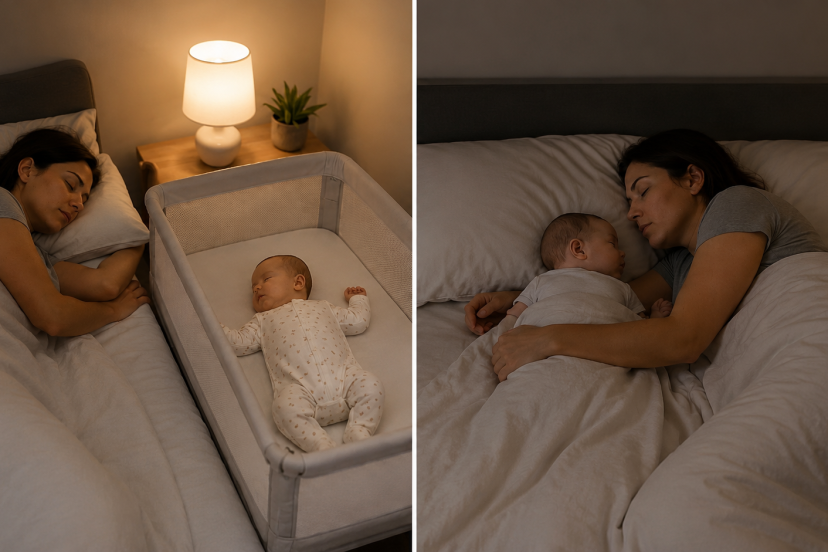
Room sharing means the baby sleeps in the same room as a parent or caregiver but on a separate surface designed for infants, such as a crib, bassinet, or portable play yard. Bed sharing means the baby and another person sleep on the same surface, including an adult bed, couch, recliner, or armchair. “Co-sleeping” is less precise because people use it for both arrangements. The National Institutes of Health’s Safe to Sleep campaign recommends using the more specific terms so families know exactly which practice is being discussed.
For babies younger than 1 year, the safer choice is room sharing without bed sharing. The American Academy of Pediatrics recommends keeping an infant’s separate sleep space in the parents’ room for at least the first six months. This arrangement keeps the baby nearby while reducing exposure to adult bedding, soft mattresses, gaps, and sleeping adults or siblings.
“Room sharing is safer than sharing your bed with baby.”
Source: Eunice Kennedy Shriver National Institute of Child Health and Human Development, Safe to Sleep® FAQ.
Key Takeaways
- Room sharing means sleeping in the same room but on separate sleep surfaces; bed sharing means sleeping together on one surface.
- The American Academy of Pediatrics recommends room sharing without bed sharing for at least the first six months.
- A baby should sleep alone, on their back, on a firm, flat, non-inclined surface with only a fitted sheet.
- Adult beds, couches, recliners, pillows, blankets, nursing pillows, positioners, and loungers should not be used as routine infant sleep spaces.
- If a caregiver accidentally falls asleep while feeding in bed, the baby should be returned to a separate sleep space as soon as the caregiver wakes.
Room Sharing and Bed Sharing Are Not the Same
In a room-sharing arrangement, the baby has a dedicated crib, bassinet, or portable play yard in the caregiver’s room. Bed sharing occurs whenever an infant sleeps on the same surface as an adult, child, or pet, whether planned or accidental. Sharing a couch or armchair is also bed sharing and can be especially hazardous because cushions and crevices can trap or cover an infant.
Why Room Sharing Is the Recommended Option
A nearby baby is easier to hear, check, feed, and comfort. The CDC states that room sharing may reduce the risk of sudden infant death syndrome by as much as 50% and is safer than bed sharing. The AAP advises keeping the infant’s separate sleep space close to the adult bed for at least the first six months; about 90% of sudden and unexpected infant deaths occur during this period.
Room sharing does not eliminate every risk, so the safe setup should be used for naps and nighttime sleep. It does, however, avoid hazards built into adult sleep environments.
Why Bed Sharing Raises Safety Concerns
Adult beds are designed for adults, not infants. They may contain pillows, sheets, comforters, mattress toppers, soft surfaces, gaps beside walls or headboards, and spaces where a baby can become wedged. An adult, sibling, or pet can also roll toward the baby or unintentionally cover the baby’s face. These conditions can contribute to suffocation, strangulation, entrapment, overheating, or falls.
The AAP does not recommend bed sharing with an infant under any circumstances, including with twins or other multiples. It also warns that couches, armchairs, and cushions are particularly dangerous. HealthyChildren.org reports that the risk of sleep-related infant death may be up to 67 times higher when an infant sleeps with someone on a couch, soft armchair, or cushion.
Being attentive or normally sleeping lightly does not remove these hazards. Fatigue and sleep reduce a caregiver’s ability to notice that the baby’s position or breathing space has changed.
Situations That Make Surface Sharing Especially Dangerous
No bed-sharing arrangement is considered risk-free by the AAP, but some circumstances increase danger further. Risk is especially high when:
- The baby is younger than 4 months.
- The baby was born prematurely or had a low birth weight.
- Anyone in the bed smokes or the baby was exposed to smoke during pregnancy.
- A caregiver has used alcohol, marijuana, opioids, illicit drugs, sleep aids, or another medication that causes drowsiness.
- The caregiver is extremely tired or has reduced alertness.
- The surface is soft, sagging, inclined, or surrounded by cushions.
- Pillows, blankets, comforters, quilts, or loose sheets are present.
- The baby shares the surface with someone other than a parent, with multiple people, with another child, or with a pet.
NIH and AAP materials identify soft surfaces, smoking, impaired alertness, substance use, very young age, and prematurity or low birth weight as important risk factors in shared sleep environments.
How to Create a Safe Room-Sharing Setup
Place a safety-approved crib, bassinet, portable crib, or play yard near the adult bed, while keeping it structurally separate and free of dangerous gaps. Use a firm, flat, level mattress and only its fitted sheet. Keep the space empty—no pillows, quilts, loose blankets, bumpers, toys, positioners, nests, or nursing pillows. CPSC calls this “Bare is Best” and advises moving a baby who falls asleep elsewhere to an approved infant sleep product.
Place the baby on their back for every sleep, including naps. Once babies can roll independently in both directions, caregivers do not need to repeatedly turn them back, but the baby should still be placed down on their back and the sleep area should remain bare. The CDC recommends a firm, flat, non-inclined surface and keeping soft bedding out of the sleep area.
Dress the baby appropriately for the room rather than adding loose blankets. A correctly sized wearable blanket or sleep sack may be used if it does not restrict breathing or movement. Weighted blankets, weighted sleep sacks, and weighted swaddles should not be used for infant sleep under AAP guidance.
What About Bedside Sleepers?
A bedside sleeper can provide a separate infant surface beside the adult bed. Use only a product intended for infant sleep, assemble it exactly as directed, and follow all age, weight, developmental, attachment, and mattress limits. Never add padding, positioners, or rolled towels. CPSC recommends compliant cribs, bassinets, play yards, and bedside sleepers for infant sleep.
Nighttime Feeding Without Routine Bed Sharing
Frequent nighttime feeding is one reason parents consider bed sharing. Room sharing can make feeding easier because the baby remains nearby while still having a separate place to sleep afterward. Bring the baby into bed to feed or comfort if needed, but return the baby to the crib or bassinet before the caregiver goes to sleep.
Because exhausted parents may unintentionally doze, it helps to plan before a feeding begins. Avoid feeding on a couch or recliner. Ask another adult to stay awake with you when possible, set a repeating alarm, keep the room moderately lit, or listen to something engaging.
When there is a real possibility of falling asleep in bed, remove pillows, blankets, and other soft items from the immediate area before feeding. This does not make bed sharing safe; it is a harm-reduction step for an accidental situation. Move the baby to their separate sleep space as soon as you wake.
Breastfeeding is associated with a lower risk of SIDS and is encouraged when possible, but it does not remove the hazards of sharing an adult sleep surface. Safe to Sleep recommends breastfeeding and room sharing while returning the infant to a separate, approved sleep space after feeding.
When Can a Baby Move to Their Own Room?
The AAP recommends room sharing without bed sharing for at least the first six months. Families may continue longer when it works well, but the separate sleep surface and other safe-sleep practices should continue throughout the baby’s first year.
Families considering an earlier move should discuss the baby’s age, birth history, health, and sleep environment with the pediatrician. In the new room, continue using an approved crib or play yard with a firm, flat mattress and fitted sheet only.
Monitors do not replace safe positioning or a safe sleep surface, and consumer heart-rate or oxygen monitors should not be treated as SIDS-prevention devices.
What If a Family Is Already Bed Sharing?
Families should discuss their real sleep arrangement honestly with the pediatrician. The preferred change is to place an approved infant sleep space beside the adult bed and transfer the baby there after feeding or soothing. Keep supplies nearby, share nighttime duties when possible, and practice transfers at naps or the beginning of the night.
Families without a crib, bassinet, or play yard can ask a pediatric clinic, hospital, public-health department, or community organization about low-cost or free safe-sleep programs. The goal is not a perfect nursery; it is a firm, flat, uncluttered infant sleep space.
The Bottom Line
For infants, closeness and separation can work together. Room sharing keeps the baby near enough for feeding, comfort, and observation while preserving a dedicated sleep surface. Bed sharing places the baby in an adult environment where bedding, soft surfaces, gaps, other people, and caregiver fatigue can create hazards.
The safest general arrangement is simple: place the baby on their back in a separate, safety-approved crib, bassinet, portable crib, or play yard in the caregiver’s room, ideally for at least the first six months. Keep the surface firm, flat, level, and bare. Use the same setup for every nap, every nighttime sleep, and every caregiver.
Frequently Asked Questions
1. Is room sharing the same as co-sleeping?
Room sharing may be described as a form of co-sleeping, but the term is ambiguous. In safe-sleep guidance, room sharing means the baby sleeps nearby on a separate infant sleep surface. Bed sharing means the baby sleeps on the same surface as another person. Using the specific terms helps avoid confusion.
2. How long should a baby sleep in the parents’ room?
The AAP recommends room sharing without bed sharing for at least the first six months, when the risk of sleep-related infant death is highest. Families can continue room sharing longer if it remains practical, while maintaining a separate, approved sleep surface.
3. Is bed sharing safe if there are no pillows or blankets?
Removing pillows and blankets may reduce some hazards, but it does not make an adult bed a safety-approved infant sleep space. Risks can remain from the mattress, gaps, entrapment, falls, caregiver movement, and impaired awareness during sleep. The AAP does not recommend bed sharing under any circumstances.
4. What should I do if I fall asleep while feeding my baby?
As soon as you wake, place the baby on their back in a separate crib, bassinet, or play yard. Avoid feeding on couches and armchairs because these surfaces are especially hazardous if a caregiver dozes. Planning nighttime feeds with alarms, another awake adult, and a nearby bassinet can reduce the chance of an accidental shared-sleep episode.
The AAP does not recommend bed sharing, including for twins or other multiples. Each infant should have a separate sleep surface designed for babies. Parents of multiples can place separate bassinets or cribs near the adult bed to preserve the benefits and convenience of room sharing.
This article provides general educational information and is not a substitute for advice from your baby’s pediatrician. Seek individualized guidance for premature babies, babies with medical conditions, or any sleep-related concern.