Best Baby Lotion: 4 Gentle Options for Dry and Sensitive Skin
*We may earn a commission for purchases made using our links. Please see our disclosure to learn more.
The best baby lotion moisturizes dry skin without adding unnecessary fragrance or making everyday care complicated. CeraVe Baby Moisturizing Lotion is a strong starting choice for its fragrance-free formula and barrier-supporting ceramides. Aveeno, Eucerin, and Baby Dove also offer worthwhile options, depending on your baby’s needs.
Choosing between them means looking beyond a familiar brand or a “hypoallergenic” label. Ingredients, skin sensitivity, and the difference between ordinary dryness and eczema matter more. This guide compares four baby lotions, explains what to look for, and covers how to use moisturizer comfortably.
“Choose fragrance-free rather than unscented products to help prevent eczema outbreaks in your child.”
— American Academy of Dermatology
Medical note: This article provides general information, not a diagnosis or individualized medical advice. Ask your baby’s pediatrician about persistent dryness, an unexplained rash, or suspected eczema.
KEY TAKEAWAYS
QUICK TIPS-
Choose Fragrance-Free
Look for a fragrance-free formula, especially for sensitive skin. “Unscented” does not always mean fragrance-free.
-
CeraVe Supports the Skin Barrier
Ceramides, hyaluronic acid, and niacinamide make CeraVe Baby Lotion a well-rounded option for everyday moisturizing.
-
Aveeno Offers Oat-Based Care
Aveeno Baby Daily Moisture Lotion combines nourishing oat with moisturizing ingredients for routine dryness.
-
Eucerin Softens Dry Skin
Eucerin Gentle Baby Lotion contains shea butter and provitamin B5 in a fragrance-free daily formula.
-
Baby Dove Suits Face and Body
Baby Dove’s fragrance-free lotion provides a convenient option for moisturizing dry facial and body skin.
-
Check Individual Tolerance
Try a new moisturizer on a small area first. Hypoallergenic formulas can still cause reactions.
-
Eczema May Need More Than Lotion
Persistent dryness or eczema may need a thicker cream or ointment. Ask your baby’s pediatrician about ongoing irritation, itching, or a worsening rash.
Best Baby Lotions at a Glance
These recommendations reflect published product formulas and dermatology guidance, rather than hands-on testing or proof that one lotion performs better for every baby.
| Product | Recommended for | Notable ingredients | Main consideration |
|---|---|---|---|
| CeraVe Baby Moisturizing Lotion | Everyday barrier support | Ceramides, hyaluronic acid, niacinamide | A lightweight lotion may be insufficient for very dry patches |
| Aveeno Baby Daily Moisture Lotion | Routine dryness | Oat, glycerin, dimethicone, petrolatum | Contains oat; consider known sensitivities |
| Eucerin Baby Lotion | Parents seeking shea butter and panthenol | Shea butter, provitamin B5 | Different from the brand’s eczema-specific products |
| Baby Dove Fragrance Free Moisture Hypoallergenic Lotion | Face-and-body moisturizing | Glycerin, petrolatum, dimethicone | Select the fragrance-free version specifically |
Formulas can change. Check the actual package, especially when replacing a previously tolerated bottle.
1. CeraVe Baby Moisturizing Lotion


CeraVe Baby Lotion gently moisturizes delicate skin with a lightweight, non-greasy feel. Formulated with vitamin E and niacinamide, it provides everyday hydration without added fragrance, dyes, parabens, or phthalates.
- Lightweight: Moisturizes without a greasy feel.
- Fragrance-Free: No added fragrance or dyes.
- Generous Size: Larger bottle for regular use.
- Limited Richness: Very dry skin may need a thicker cream.
- Bulky Bottle: Less convenient for travel.
- Individual Sensitivity: Some babies may not tolerate every ingredient.
Best for Everyday Skin Barrier Support
CeraVe Baby Moisturizing Lotion is a sensible first option when you want a fragrance-free moisturizer with ingredients chosen to support the skin’s protective barrier.
Its published formula contains three ceramides, hyaluronic acid, niacinamide, and vitamin E. Ceramides are lipids found naturally in the skin barrier, while hyaluronic acid helps retain moisture. The manufacturer describes the lotion as lightweight and non-greasy and lists it as accepted by the National Eczema Association.
That combination makes it an appealing choice for parents who want a lotion for larger areas, such as the arms, legs, and torso. A spreadable product can make moisturizing easier when your baby is wriggling through the bedtime routine.
Reasons to consider it:
- Fragrance-free formula.
- Includes ceramides and moisture-retaining ingredients.
- Designed for routine baby skin care.
What to keep in mind: The baby lotion and baby cream are separate products. If the skin remains rough or uncomfortable after lotion, a thicker moisturizer may be more appropriate.
Who it suits: Families seeking an uncomplicated daily moisturizer, particularly when mild dryness is the main concern.
2. Aveeno Baby Daily Moisture Lotion


Aveeno Baby Daily Moisture Body Lotion moisturizes delicate skin with nourishing oat in a fragrance-free, hypoallergenic formula. Suitable for sensitive skin, this two-pack includes two 18-ounce bottles for everyday use.
- Fragrance-Free: No added scent.
- Nourishing Oat: Helps moisturize dry skin.
- Convenient Two-Pack: Provides 36 ounces for regular use.
- Oat Sensitivity: Unsuitable for babies sensitive to oat.
- Large Bottles: Less convenient for travel.
- Limited Richness: Very dry skin may need a thicker cream.
Best Oat-Based Option for Routine Dryness
Aveeno Baby Daily Moisture Lotion is another useful fragrance-free choice. Its formula combines oat with glycerin, petrolatum, and dimethicone, bringing together ingredients that attract moisture and help limit moisture loss.
Aveeno describes the product as fast-absorbing and non-greasy and reports 24-hour moisturization. That duration is a manufacturer claim; individual results depend on your baby’s skin, bathing routine, and environment.
The formula is worth considering for ordinary dry areas that need regular moisturizing without the heavier feel associated with an ointment. Its combination of moisturizing ingredients also makes it a practical option after bathing.
Reasons to consider it:
- Fragrance-free.
- Combines oat with several complementary moisturizing ingredients.
- Available in different package sizes.
What to keep in mind: This is the Daily Moisture Lotion, not the brand’s Eczema Therapy Cream. Similar packaging does not mean the formulas or intended uses are interchangeable.
It also contains oat. If your baby has a known oat allergy or previously reacted to an oat-containing skin product, ask their clinician before using it.
Who it suits: Parents looking for an oat-based lotion for routine dryness, provided their baby tolerates the ingredients.
3. Eucerin Baby Lotion


Eucerin Gentle Baby Lotion moisturizes delicate skin with provitamin B5 and natural shea butter. Its fragrance-free formula helps soften dry skin and provides a simple option for everyday baby care.
- Moisturizing Ingredients: Contains shea butter and provitamin B5.
- Fragrance-Free: No added fragrance or dyes.
- Daily Care: Formulated for regular moisturizing.
- Limited Richness: Very dry patches may need a thicker cream.
- Travel Size: The 13.5-ounce bottle is bulky for packing.
- Individual Sensitivity: Ingredient reactions are still possible.
Best Shea Butter and Provitamin B5 Option
Eucerin Baby Lotion is worth considering if you prefer a fragrance-free moisturizer built around shea butter and provitamin B5, also called panthenol.
The manufacturer identifies both as moisturizing ingredients and states that the lotion is free of fragrance, dyes, and drying alcohols. It is intended for everyday moisturizing of babies’ delicate skin.
This makes it a straightforward candidate for a simple routine: gentle cleansing when needed, followed by moisturizer on dry skin. There is no need to pair it with several matching products for the lotion to serve its purpose.
Reasons to consider it:
- Fragrance-free and dye-free.
- Includes shea butter and panthenol.
- Designed for everyday use.
What to keep in mind: Eucerin Baby Lotion is different from Eucerin Baby Eczema Relief Cream. Read the full product name before purchasing, particularly if a clinician recommended a specific formula.
Also, “free of drying alcohols” should not be confused with avoiding every ingredient containing the word alcohol. Ingredient names alone do not explain how a finished moisturizer behaves.
Who it suits: Families seeking a daily lotion with shea butter and panthenol, rather than a specialized eczema product.
4. Baby Dove Fragrance Free Moisture Hypoallergenic Lotion


Baby Dove Sensitive Skin Care Lotion moisturizes delicate skin with a gentle, fragrance-free formula. Designed for sensitive skin, this hypoallergenic lotion comes in a generous 20-ounce bottle for everyday use.
- Fragrance-Free: No added scent.
- Sensitive Skin Formula: Designed for gentle moisturizing.
- Generous Size: Provides 20 ounces for regular use.
- Bulky Bottle: Less convenient for travel.
- Limited Richness: Very dry skin may need a thicker cream.
- Individual Sensitivity: Hypoallergenic does not guarantee no reactions.
Best Face-and-Body Option
Baby Dove Fragrance Free Moisture Hypoallergenic Lotion offers a practical option for parents who want one moisturizer labeled for both the face and body.
Its published ingredient list includes glycerin, petrolatum, and dimethicone. These ingredients help hydrate skin and reduce moisture loss. Dove identifies this version as fragrance-free and suitable for newborn skin.
For families trying to keep bath time manageable, a single face-and-body product can be convenient. Use a small amount on dry facial areas, keeping it away from the eyes and mouth.
Reasons to consider it:
- Fragrance-free formula.
- Labeled for face-and-body use.
- Contains established moisturizing ingredients.
What to keep in mind: Baby Dove sells several products with similar branding. Choose the fragrance-free version specifically rather than assuming every bottle has the same formula.
Although the product is marketed as hypoallergenic, that wording does not guarantee that an individual baby cannot develop irritation.
Who it suits: Parents seeking a multipurpose lotion for ordinary dryness on the face and body, when tolerated.
How to Choose the Best Baby Lotion
Prioritize Fragrance-Free Formulas
A pleasant scent is unnecessary for effective moisturizing. For eczema-prone children, the American Academy of Dermatology recommends fragrance-free products and explains that “unscented” products may contain ingredients that mask an odor.
Check the label rather than relying on descriptions such as gentle, calming, or sensitive. Those terms do not necessarily tell you whether fragrance has been added.
Look for Ingredients That Work Together
Moisturizers commonly combine ingredients with different roles:
- Humectants, such as glycerin and hyaluronic acid, help retain water.
- Emollients, such as shea butter and other lipids, soften rough skin.
- Occlusive ingredients, such as petrolatum and dimethicone, help reduce water loss.
The complete formula matters more than finding one fashionable ingredient. A higher price or a longer list of plant extracts does not automatically make a lotion more suitable.
Match the Texture to the Dryness
Lotion is convenient for mild dryness and easy application over larger areas. More persistent dryness may respond better to a thicker product.
For children with eczema, the American Academy of Pediatrics recommends fragrance-free creams or ointments and notes that thinner lotions are less effective at moisturizing this particularly dry skin.
If lotion needs constant reapplication without keeping your baby comfortable, reassess the texture and discuss ongoing symptoms with their pediatrician.
Consider Tolerance and Value
Choose a moisturizer you can afford to use consistently. Compare the price per ounce rather than bottle price alone, but consider starting with a smaller package when introducing a new formula.
An expensive lotion is poor value if it causes irritation or remains unused. A modestly priced product that your baby tolerates comfortably may be the better choice.
Baby Lotion vs. Cream vs. Ointment
These textures serve different needs.
| Type | Typical characteristics | When it may be useful |
|---|---|---|
| Lotion | Lighter and easier to spread | Mild dryness and larger areas |
| Cream | Thicker and richer | More persistent dry skin |
| Ointment | Greasier and more occlusive | Very dry patches or clinician-directed eczema care |
A lotion can be perfectly adequate for routine dryness without being the right choice for an inflamed eczema flare.
The American Academy of Dermatology advises that eczema care may include moisturizers, prescription medicines, and identifying triggers. Moisturizer supports that plan; it does not replace treatment for inflammation when medication is needed.
How to Apply Baby Lotion
Introduce One Product at a Time
Try a new moisturizer on a small area first and watch for irritation before applying it widely. Mayo Clinic recommends this approach when introducing a moisturizer to a child with eczema. A tolerated small application does not guarantee that a later reaction is impossible.
Introducing several lotions, washes, and oils together makes it harder to identify which product caused a problem.
Apply After Gentle Bathing
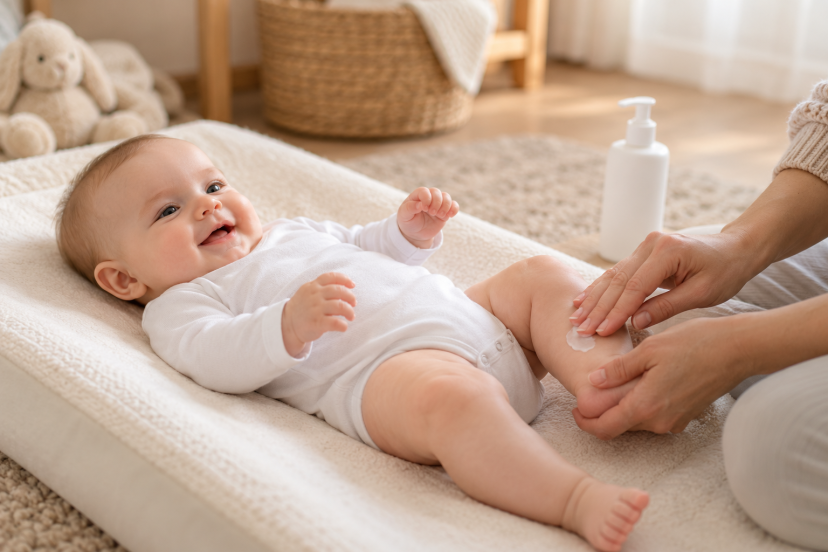
Use lukewarm water and gentle handling. Afterward, pat the skin rather than rubbing it and apply moisturizer while the skin is slightly damp.
For babies with eczema, Mayo Clinic recommends short baths followed by a fragrance-free cream or ointment on damp skin. The same gentle handling helps avoid unnecessary friction during everyday care.
Adjust to Your Baby’s Needs
Follow the product label and any instructions from your pediatrician. The amount and frequency needed will depend on whether your baby has occasional dryness, ongoing eczema, or another skin condition.
Use gentle strokes rather than vigorous massage on irritated areas. Stop using a product if it appears to cause persistent redness, discomfort, or a worsening rash.
When Dry Skin Needs Medical Attention
A rash should not automatically be treated as simple dryness.
Contact your baby’s pediatrician if the skin stays inflamed, itching interferes with sleep, or moisturizing does not help. Yellowish crusting, pus-filled spots, or sores can indicate infection and need medical assessment. The American Academy of Dermatology specifically identifies these as reasons to seek care
Avoid repeatedly switching products while a rash worsens. A clinician can help distinguish eczema from irritation, infection, or another condition and recommend appropriate treatment.
Choosing a Lotion That Fits Your Baby
CeraVe is a well-rounded starting option for barrier-supporting ingredients. Aveeno offers an oat-based formula, Eucerin combines shea butter with panthenol, and Baby Dove provides a fragrance-free face-and-body choice.
Start with your baby’s actual needs: a fragrance-free formula, a suitable texture, and ingredients they tolerate. If ordinary lotion leaves the skin persistently uncomfortable, seek advice about a richer moisturizer or treatment.
Frequently Asked Questions
1. What is the best baby lotion for sensitive skin?
A fragrance-free moisturizer that your baby tolerates is the best starting point. CeraVe Baby Moisturizing Lotion is one option, alongside the other fragrance-free formulas listed here. No product is universally suitable, so introduce a new lotion on a small area first and monitor for irritation.
2. Can you use lotion on a newborn?
Some baby lotions are labeled as suitable for newborn skin, but whether your newborn needs one depends on their skin and medical circumstances. Follow age-related labeling and ask your pediatrician about significant peeling, persistent dryness, or a rash. Premature babies may need individualized skin-care guidance.
3. How often should you apply baby lotion?
Apply according to the label and your baby’s needs, particularly after bathing or when dry areas appear. Babies with eczema may need a more structured moisturizing routine. Mayo Clinic recommends moisturizing eczema-prone skin at least twice daily, using an appropriate fragrance-free cream or ointment.
4. Can baby lotion be used on the face?
Yes, if the product is labeled for facial use and your baby tolerates it. Apply a small amount to dry areas, avoiding the eyes and mouth. Persistent cheek redness, cracking, or a drool-related rash may require a different approach, so seek advice if routine moisturizing does not help.
5. Is baby lotion enough for eczema?
Often, a thicker cream or ointment is more appropriate. Lotion may help mild dryness, but eczema can also require prescribed treatment for inflammation. The American Academy of Pediatrics recommends fragrance-free creams or ointments as part of eczema care rather than relying on thinner lotions alone.