What Are Contact Naps? Benefits, Safety, and How to Transition

*We may earn a commission for purchases made using our links. Please see our disclosure to learn more.
A contact nap is a daytime sleep period during which a baby sleeps while being held against or supported by an awake caregiver.
For many families, contact naps bring calm, closeness and longer stretches of daytime sleep. They can also leave a caregiver unable to move, meet basic needs or rest. Both experiences can be true. The central safety rule is nonnegotiable: the caregiver must remain fully awake, alert and unimpaired throughout the nap. If the caregiver needs to sleep, the baby should be placed on the back in a separate crib, bassinet, portable crib or play yard with a firm, flat surface.
Safe-sleep recommendations apply to naps as well as nighttime sleep: place the baby on the back on a firm, flat, level surface designed for infant sleep, with no soft objects or loose bedding.
Key Takeaways
- A contact nap means the baby sleeps while physically supported by an awake caregiver.
- The safest recommended sleep location is a separate, approved infant sleep surface.
- Contact naps become dangerous when the caregiver falls asleep, becomes impaired or cannot keep the baby’s airway clear.
- Contact napping can become a familiar sleep association, but it is not an addiction or a permanent developmental problem.
- Families can transition gradually by practicing one crib nap at a time and reducing support in manageable steps.
What Is a Contact Nap?
A contact nap occurs when a baby remains in physical contact with a caregiver for most or all of a daytime nap.
The baby may sleep in the caregiver’s arms, across the caregiver’s lap or against the caregiver’s chest. Some parents also use the term for sleep in a baby carrier or sling, although carrier sleep involves additional positioning and airway considerations.
Contact naps often begin during feeding. A baby falls asleep at the breast or bottle, relaxes against the caregiver and remains there because an attempted transfer causes waking. In other cases, a caregiver intentionally holds the baby because it is the only reliable way to obtain a needed nap.
Contact Naps Versus Similar Practices
| Practice | What It Means | Primary Safety Consideration |
|---|---|---|
| Contact nap | Baby sleeps while held by an awake caregiver | Caregiver must remain awake and keep the airway visible |
| Skin-to-skin care | Baby rests directly against a caregiver’s bare chest | Follow positioning guidance and remain alert |
| Babywearing | Baby is carried in a fitted sling or carrier | Prevent chin-to-chest positioning and monitor frequently |
| Bed-sharing | Baby and adult sleep on the same surface | Not recommended because it increases sleep-related risk |
| Room-sharing | Baby sleeps in a separate approved space in the caregiver’s room | Recommended because the baby remains close without sharing a surface |
| Independent nap | Baby sleeps in a crib, bassinet, portable crib or play yard | Place baby on the back on a firm, flat surface |
A baby sleeping unattended on a lounger or nursing pillow is not taking a contact nap. The baby is sleeping on a product that is not designed to serve as a safe infant sleep surface. Nursing pillows should be used only for feeding support, not for infant sleeping or lounging.
Why Do Babies Prefer Contact Naps?
Babies often prefer contact naps because a caregiver’s body provides familiar sensory input and immediate support during transitions between waking and sleep.
Newborns arrive with immature sleep organization and limited ability to regulate distress without help. The warmth, pressure, smell, movement and sound of a familiar caregiver can make settling easier. This does not mean a baby is being manipulative or deliberately refusing the crib. It means the conditions provided by contact are easier for that baby to tolerate at that stage.
Newborn sleep is also fragmented. Newborns may sleep for much of the day while waking every one or two hours, and more regular sleep cycles generally do not emerge until around four months. Wide variation is normal during the early months.
Contact Supports Co-Regulation
Co-regulation describes the way a responsive adult helps an infant return to a calmer state. Holding, feeding, rocking and speaking softly can all contribute to that process.
Research supports meaningful benefits from close physical contact, particularly skin-to-skin care. Studies have associated skin-to-skin contact with changes in infant sleep, crying, physiological regulation and feeding. However, skin-to-skin research should not be treated as direct proof that every fully clothed contact nap produces the same outcomes.
Why Babies Wake When Put Down
A transfer changes several conditions at once. The baby moves away from warmth, body pressure, movement and familiar sound. The supporting surface changes, and the caregiver’s hands shift position. A baby in lighter sleep may respond to that transition by startling, moving or waking.
This is not evidence that the crib is harmful or that the baby is incapable of independent sleep. It means the transfer created enough sensory change to trigger arousal.
Active newborn sleep can include twitching, jerking, facial movement and irregular sounds. Parents sometimes mistake active sleep for waking and intervene before the baby has fully awakened. Waiting briefly while watching the baby’s breathing and behavior may reveal that the baby is still asleep.
Why Contact Naps May Last Longer
During a contact nap, a caregiver can respond immediately when the baby begins to stir. Gentle movement, pressure or feeding may help the baby return to sleep before becoming fully alert.
A longer nap is not automatically a better nap, however. Sleep quality cannot be judged only by duration, and a long contact nap does not override safe-sleep guidance. The goal is adequate total sleep within a safe and sustainable family routine.
Benefits of Contact Naps
Contact naps can provide closeness, facilitate settling and help families protect daytime sleep during demanding developmental periods.
Their practical value is often greatest in the newborn period, when sleep is irregular and frequent feeding is normal. A supported nap may also help during travel, routine disruption, developmental changes or recovery from a minor illness.
Easier Settling
Babies who become distressed during crib transfers may settle quickly when held. In the short term, this can prevent a prolonged cycle of crying, repeated transfers and increasing fatigue.
Contact is one tool for responding to a baby’s needs. It is not the only responsive option, and parents do not have to choose between constant holding and leaving a baby unsupported.
Closeness and Connection
Holding a sleeping baby can create quiet time for physical connection. Many parents value these moments, especially during a brief stage of infancy.
At the same time, attachment is built through a broad pattern of responsive care. Feeding, comforting, talking, playing, making eye contact and responding during waking hours all matter. Contact naps alone do not determine attachment quality, and independent naps do not weaken the parent-child relationship.
Protecting Total Daytime Sleep
A planned contact nap can serve as a rescue strategy when every crib attempt ends quickly. This can be more useful than repeating transfers until both baby and caregiver are overwhelmed.
Rescue naps do not have to become the permanent routine. A family may practice one crib nap while supporting the remaining naps in whatever safe, workable way produces adequate rest.
Supporting Skin-to-Skin Time
Skin-to-skin contact has established roles in newborn and preterm care, including support for temperature regulation, feeding and parent-infant interaction. When skin-to-skin time leads to sleep, the supervising adult should remain awake and follow guidance from the hospital or pediatric care team. When skin-to-skin time ends, the baby should be placed on the back in a separate approved sleep space.
Are Contact Naps Safe?
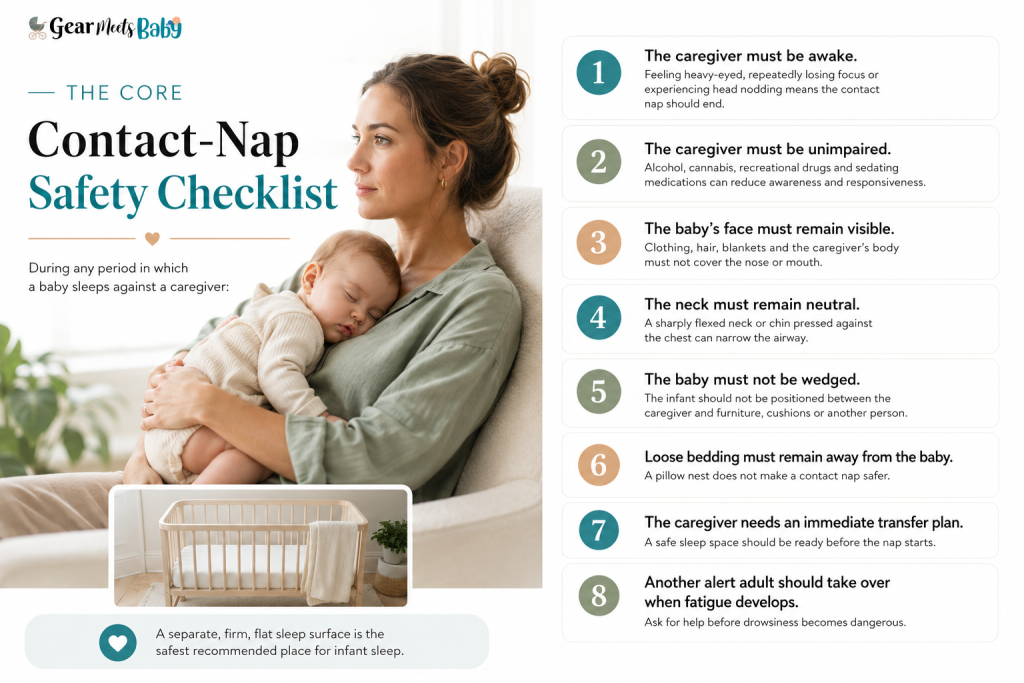
A contact nap requires continuous supervision by a fully awake caregiver, while a separate firm, flat sleep surface remains the safest recommended setting for infant sleep.
An awake contact nap and a sleeping adult holding a baby are not equivalent situations. Once the caregiver falls asleep, the adult cannot reliably monitor the baby’s airway, position, temperature or movement.
This distinction matters because approximately 3,700 infants in the United States die from sudden unexpected infant death each year. This category includes sudden infant death syndrome, unexplained deaths, and accidental suffocation or strangulation in the sleep environment.
The Safest Standard for Every Nap
For all sleep periods, the baby should be:
- Placed on the back
- On a firm, flat and level surface
- In a safety-approved crib, bassinet, portable crib or play yard
- On a fitted sheet with nothing else in the sleep area
- In a smoke-free environment
- Dressed to avoid overheating
The back sleep position remains the recommended position for infants, including babies born prematurely and babies with reflux. Side sleeping is not considered a safe alternative because it is unstable.
Why Couches, Recliners and Armchairs Are Dangerous
Couches and soft chairs create gaps where a baby can become trapped between the adult and the furniture. Cushions and soft upholstery can also obstruct breathing.
The risk of sleep-related infant death may be up to 67 times higher when an infant sleeps with another person on a couch, soft armchair or cushion. This risk applies when the adult falls asleep, which is why an exhausted caregiver should not settle in a location where accidental sleep is likely.
Recliners deserve particular caution. A caregiver may slide downward after falling asleep, while the baby may shift into a gap or become compressed against the adult’s body.
Can a Baby Contact Nap on a Caregiver’s Chest?
A baby may fall asleep against an awake caregiver’s chest, but the arrangement depends entirely on the caregiver remaining alert and maintaining a clear airway.
The baby’s face should remain visible, the neck should not be sharply bent and no blanket should cover the face. The caregiver should not lie down and sleep with the baby on the chest. As soon as the caregiver becomes tired, the baby should be transferred to an approved sleep surface.
A photograph of a sleeping adult with a baby on the chest may look peaceful, but it depicts a different risk situation from an alert adult actively monitoring the baby.
Are Contact Naps in a Carrier Safe?
A carrier nap requires careful positioning and frequent monitoring. Some slings can curl a young baby into a C-shape that brings the chin toward the chest and restricts breathing. The caregiver should follow the carrier’s age, weight and positioning requirements and check the baby frequently.
The baby should be high enough to monitor easily, with the face uncovered and the nose and mouth free. The head and neck must receive appropriate support.
Carriers and slings are not recommended as routine infant sleep spaces. If a baby falls asleep in a carrier, sling, stroller, swing or car seat, the American Academy of Pediatrics advises moving the baby to a firm, flat surface on the back as soon as possible.
Nursing Pillows and Loungers Are Not Sleep Spaces
A nursing pillow may support the caregiver’s arms during an awake feeding, but it should not support a sleeping baby independently. The Consumer Product Safety Commission advises transferring a baby to a safe sleep space if the baby falls asleep during feeding or the caregiver begins to feel sleepy.
Infant loungers, nests and support cushions can create suffocation, entrapment and fall hazards. Product names or marketing images do not establish that an item complies with federal infant sleep standards. Recent federal warnings and recalls continue to involve loungers that create unsafe sleeping environments.
Contact Naps After Feeding
Feeding naturally makes some babies and caregivers sleepy. Before beginning a feed, the caregiver should assess personal fatigue honestly.
A safer plan may include:
- Feeding away from a couch or recliner
- Keeping the room adequately lit
- Asking another adult to remain nearby
- Setting an alert as a backup
- Removing pillows and loose blankets from the immediate area
- Preparing the crib or bassinet in advance
- Transferring the baby as soon as drowsiness develops
The AAP specifically recommends avoiding couches and armchairs when there is a possibility of falling asleep during feeding.
Are Contact Naps Normal?
Contact naps are common during infancy, particularly while sleep cycles, feeding patterns and self-regulation are still developing.
There is no medically established age at which every baby must stop contact napping. Some babies accept a bassinet early. Others require repeated, gradual practice before they tolerate a transfer.
For infants from four through twelve months, the general recommendation is 12 to 16 hours of sleep in each 24-hour period, including naps. No single sleep-duration recommendation is given for younger infants because normal newborn sleep varies widely.
The more useful questions are:
- Is the arrangement safe?
- Is the caregiver able to remain awake?
- Is the baby feeding and growing appropriately?
- Is the routine sustainable?
- Does the family want greater flexibility?
Is a Baby Too Old for Contact Naps?
Age alone does not make an awake contact nap emotionally inappropriate. An older baby may still seek contact during illness, travel, teething or routine disruption.
However, the physical demands increase as a baby grows. The caregiver may experience back, neck, shoulder or pelvic discomfort. A larger and more mobile baby may also be harder to position safely for a long period.
These practical changes often motivate a transition even when the family still enjoys occasional contact naps.
Do Contact Naps Create a Bad Habit?
Contact naps can become a strong sleep association, but they do not create an addiction or prove that a baby will never sleep independently.
A sleep association is simply a cue that becomes linked with falling asleep. Adults also rely on associations, including a familiar pillow, room temperature, darkness or a preferred sleeping position.
Holding, feeding and rocking are high-involvement associations because the caregiver must reproduce them. A crib, sleep sack, short routine or consistent phrase is easier to maintain without continuous physical support.
The AAP notes that babies who are always held or rocked completely to sleep may have more difficulty returning to sleep after waking. That is a possibility, not a guarantee, and it does not mean responsive holding is harmful.
Preference Is Not Permanent Dependency
A baby may protest when an established condition changes. That protest shows that the new condition is unfamiliar, not that the baby has been damaged by the old one.
Independent napping develops through a combination of neurological maturation, temperament, repeated experience and environmental consistency. A baby can learn a new sleep pattern while continuing to receive comfort and responsive care.
Babies Can Learn More Than One Nap Routine
Many babies sleep differently with different caregivers. A baby may contact nap with a parent, nap in a crib with a grandparent and sleep in a designated space at daycare.
This flexibility shows that consistency does not require every person to use an identical method. A short sequence of repeatable cues can help the baby understand what comes next even when the settling technique varies.
Do Contact Naps Ruin Nighttime Sleep?
Contact naps do not automatically cause frequent night waking. Night sleep can be affected by many factors, including feeding, developmental changes, total daytime sleep, bedtime timing, illness, environment and the baby’s existing sleep associations.
A baby who contact naps may sleep well at night. A baby who takes every nap in a crib may still wake frequently. Daytime sleep practices should be evaluated as one part of the overall pattern rather than treated as the sole explanation.
When Should Contact Naps Stop?
Contact naps should change when they become unsafe, physically painful, emotionally unsustainable or incompatible with the family’s daily responsibilities.
A transition deserves priority when the caregiver:
- Regularly becomes drowsy
- Has nearly fallen asleep while holding the baby
- Experiences significant pain or numbness
- Cannot eat, hydrate or use the bathroom when needed
- Feels trapped, panicked or resentful
- Cannot safely supervise another child
- Needs another caregiver to manage naps
- Is returning to work or preparing for daycare
A transition does not have to mean ending all contact naps. The initial goal may be one crib nap, an easier transfer or the ability for another caregiver to settle the baby.
Reasons Not to Rush
A very young newborn may still need extensive settling support. Families may also choose to delay a major change during illness, travel, feeding difficulties or another period of instability.
When contact naps remain safe and enjoyable, there is no requirement to eliminate them solely because another family follows a different routine.
How to Transition From Contact Naps to Crib Naps
A gradual transition works by preserving familiar sleep cues while changing one part of the falling-asleep process at a time.
The objective is not to force a baby to become independent overnight. It is to make the crib predictable and reduce the amount of support required at a pace the family can sustain.
Step 1: Define a Specific Goal
“Stop contact naps” is broad. A measurable goal is easier to work toward.
Examples include:
- Complete the first nap in the crib
- Transfer the baby without immediate waking
- Let another caregiver handle one nap
- Replace constant rocking with still holding
- Settle the baby beside the crib instead of across the room
Step 2: Choose One Practice Nap
Begin with the most predictable nap rather than changing every nap at once. Many families find the first nap easier because the baby is rested and the day has not yet become overstimulating.
Keep the remaining naps supported while the baby learns. This protects total sleep and reduces pressure on a single attempt.
Step 3: Create a Short Pre-Nap Routine
A useful routine may last only a few minutes:
- Check feeding and diaper needs.
- Move to the sleep space.
- Dim the room.
- Put on appropriate sleep clothing.
- Use a consistent phrase, song or sound.
- Begin the chosen settling method.
The routine should be short enough to repeat. An elaborate ritual may become difficult to maintain away from home or with another caregiver.
Step 4: Prepare the Sleep Space
The crib or bassinet should be ready before settling begins. Use a firm, flat mattress with a fitted sheet and no additional objects.
Place the baby on the back. Do not use pillows, rolled towels, wedges or positioners to recreate the sensation of being held. Inclines do not improve reflux and can create airway and sliding risks.
Step 5: Choose a Transition Method
Fully Asleep Transfer
This approach may be appropriate for a young baby or an early practice stage.
Hold the baby until the body appears relaxed. Keep the baby close while lowering into the crib, place the baby flat on the back, and maintain gentle hand contact briefly before withdrawing.
This is a practical technique, not a guarantee. A baby may still wake because the environment has changed.
Calm and Sleepy Transfer
Settle the baby until calm, then place the baby down before sleep is complete. Use a steady hand, soft voice or rhythmic patting while the baby remains on the back.
If distress steadily escalates, pick the baby up, help the baby calm and try again. Responsive practice does not require leaving a young baby to cry alone.
Gradual Fading
Gradual fading reduces support in stages:
- Rock until asleep.
- Hold without rocking until asleep.
- Hold until calm, then transfer.
- Settle with a hand on the body.
- Sit beside the crib using voice.
- Reduce involvement as the baby adapts.
A family may remain at one stage for several days before making another change.
Step 6: Treat “Drowsy but Awake” as an Option
“Drowsy but awake” is often presented as a universal rule. It is better understood as one settling strategy.
Some babies accept it. Others become fully alert during the transfer, especially in the newborn period. A baby does not fail a developmental milestone by needing more support.
The more useful goal is gradual familiarity with the sleep space, not perfect execution of one phrase.
Step 7: Use Rescue Naps
A rescue nap is a supported nap used after a crib attempt ends early or fails. It can prevent every nap from becoming a prolonged struggle.
For example, the family might attempt the crib for the first nap and use a supervised contact nap later if the baby has accumulated too little sleep. This preserves rest while maintaining daily practice.
Step 8: Evaluate Patterns, Not Individual Naps
Progress may appear as:
- Less crying before the crib
- A successful transfer even if the nap is short
- Longer periods in the crib
- Less movement required for settling
- Another caregiver completing the routine
- Faster recovery after a failed attempt
One difficult nap does not erase earlier progress.
A Gentle Seven-Day Transition Framework
A one-week framework can organize practice, but it should not be treated as a deadline or guarantee.
Day 1: Observe
Record approximate nap times, sleep cues, feeding patterns, transfer attempts and the conditions associated with the easiest nap.
Day 2: Introduce the Routine
Use the same brief pre-nap sequence before every nap, including contact naps. This separates the sleep cue from the final sleep location.
Day 3: Attempt One Crib Nap
Choose the most predictable nap. Use the usual level of holding or rocking, then attempt a safe transfer.
Day 4: Repeat the Same Nap
Do not add more crib naps yet. Repetition makes the process easier to evaluate.
Day 5: Reduce One Layer of Support
Rock less, hold without movement, or shorten the period of holding before transfer.
Day 6: Involve Another Caregiver
Let another trusted caregiver use the same routine. Babies sometimes accept a new method more easily from someone who is not associated with feeding.
Day 7: Review
Identify which part improved and where the process broke down. Continue the successful stage rather than escalating simply because the week ended.
Some babies adjust quickly. Others require several weeks of low-pressure repetition.
Why the Crib Transfer Keeps Failing
A failed transfer usually reflects timing, sensory change, discomfort or developmental readiness rather than poor parenting.
Baby Wakes Immediately
Check whether the baby is hungry, uncomfortable, congested or insufficiently tired. Keep the baby close to the caregiver’s body during lowering and withdraw support gradually.
Always finish the transfer with the baby flat on the back. Do not leave the baby sleeping on the side because that happened to preserve the transfer.
Baby Sleeps Only 20 to 40 Minutes
Short naps can occur when the baby completes one sleep cycle and cannot yet reconnect to another without help.
When the baby wakes calmly, pause briefly before intervening. The baby may return to sleep. When the baby becomes distressed, attempt a short resettling period or use a rescue nap.
The target is not necessarily a two-hour crib nap. An initially short but safe crib nap can still represent progress.
Baby Cries When Approaching the Crib
Repeated difficult transfers may cause the crib routine itself to predict frustration. Rebuild familiarity while the baby is awake. Spend a few calm minutes near the crib, sing the nap song or place the baby in the crib briefly during a content period while supervising.
The crib should remain empty during sleep, but it does not have to be emotionally unfamiliar.
Baby Accepts the Crib at Night but Not for Naps
Daytime sleep pressure is usually lighter, and daylight and household activity provide more stimulation. A baby may therefore require more support for naps despite settling well at bedtime.
Treat daytime sleep as a related but separate skill. Nighttime success does not guarantee immediate nap success.
Progress Suddenly Disappears
Temporary regressions can occur with illness, travel, feeding changes, new motor skills, separation awareness or a changing nap schedule.
Return to the last successful level of support. Additional comfort during a difficult week does not permanently erase learning.
Contact Naps in Special Circumstances
Medical conditions, prematurity, feeding concerns and respiratory symptoms require individualized advice rather than generic sleep strategies.
Premature or Low-Birth-Weight Babies
Premature and low-birth-weight infants may have additional breathing, feeding, temperature-regulation or growth considerations. Families should follow the neonatal or pediatric care team’s instructions for skin-to-skin care, feeding and safe sleep.
Back sleeping on a firm, flat surface remains the standard recommendation for premature infants unless the treating medical team gives a specific alternative for a monitored medical reason.
Babies With Reflux
Reflux does not make inclined sleep safer. Healthy infants with reflux should still be placed flat on the back. Raising the mattress or using a positioner can cause the baby to slide and may interfere with breathing.
A caregiver may hold a baby upright while awake after feeding if advised, but should transfer the baby to a safe sleep space before the caregiver sleeps.
Babies With Breathing or Airway Conditions
Frequent snoring, repeated breathing pauses, persistent high-pitched breathing, labored breathing or color changes deserve medical evaluation. These symptoms should not be managed simply by changing the nap position.
Babies Who Must Be Awakened for Feeds
Some newborns, particularly those with jaundice, prematurity or slow weight gain, may need scheduled waking for feeds. A long contact nap should not replace a medically recommended feeding schedule.
Contact the pediatrician when a newborn rarely becomes alert, does not wake for feeds or seems too tired to eat.
Daycare and Multiple Caregivers
A baby does not have to reproduce the home routine exactly at daycare. Share the baby’s safe-sleep needs, settling cues, feeding schedule and known difficulties with every caregiver.
All caregivers should follow the same safety standard even when settling methods differ.
Protecting the Caregiver During the Contact-Nap Phase
A sleep routine is not sustainable when it repeatedly compromises caregiver safety, nutrition, physical recovery or mental health.
Contact naps can occupy several hours of a day. Over time, the caregiver may delay meals, restrict fluids, ignore pain or avoid using the bathroom because moving will wake the baby.
Prepare Before the Nap
Before settling the baby:
- Use the bathroom
- Drink water
- Eat when needed
- Place the phone within reach
- Prepare the safe sleep space
- Tell another adult that the nap is beginning
- Assess personal fatigue honestly
Preparation can improve comfort, but it should never be used to justify continuing when drowsiness begins.
Partners, relatives and other trusted caregivers can take turns holding, settling or transferring the baby. This gives the primary caregiver time to sleep, recover or complete necessary tasks.
Every caregiver needs the same safe-sleep information. A baby is not protected merely because the adult has experience with children.
Protect Posture
Support the caregiver’s back and feet without placing loose pillows or blankets near the baby’s face. Change position between naps and stop when numbness, significant pain or weakness develops.
The safest response to escalating discomfort is to transfer the baby, not to maintain an unstable hold.
Recognize Dangerous Fatigue
Warning signs include:
- Head nodding
- Repeated yawning
- Losing track of time
- Dropping the phone
- Brief lapses in awareness
- Heavy eyelids
- Difficulty focusing on the baby’s face
These signs mean the caregiver is no longer reliably alert. Transfer the baby immediately or ask another awake adult to take over.
Bonding Does Not Depend on Naps
Parents who dislike contact naps are not less attached to their babies. Bonding can occur through feeding, conversation, play, bathing, skin-to-skin time while awake and reliable responses to distress.
A caregiver is allowed to need physical space.
When to Speak With a Pediatrician
Unusual sleepiness, feeding difficulty, poor growth or breathing concerns should be evaluated medically rather than treated as ordinary contact-nap behavior.
Contact a pediatrician when the baby:
- Is consistently difficult to wake
- Does not wake for feeds
- Is too tired or uninterested to eat
- Is gaining weight poorly
- Has frequent pauses in breathing
- Has persistent noisy or labored breathing
- Repeatedly chokes or gags
- Experiences a sudden major change in sleep
- Appears to be in pain
- Cannot sleep safely despite repeated adjustments
Seek emergency help for severe breathing difficulty, inability to wake, or pale, gray or blue discoloration of the skin or lips.
Frequently Asked Questions
Are contact naps safe?
A contact nap depends on a fully awake, alert and unimpaired caregiver who can continuously monitor the baby’s position and airway. A separate crib, bassinet, portable crib or play yard with a firm, flat surface remains the safest recommended place for infant sleep.
What counts as a contact nap?
A contact nap occurs when a baby sleeps while being held or physically supported by a caregiver. Common examples include sleeping in a caregiver’s arms, against the chest or in a properly fitted carrier.
Are contact naps bad for babies?
Contact naps are not inherently emotionally harmful. They can provide closeness and help a baby settle. The principal concern is physical safety, especially the possibility that the caregiver may fall asleep.
Do contact naps cause dependency?
Contact naps may become a preferred sleep association, but they do not create an addiction or permanent inability to sleep alone. Babies can learn additional sleep cues through gradual, repeated practice.
When should contact naps stop?
There is no universal age. They should change when the caregiver cannot remain awake, the position is unsafe, the routine causes pain or distress, or the family needs greater flexibility.
Why does my baby wake as soon as I put them down?
The transfer changes warmth, pressure, movement, smell and support. A baby in light sleep may wake in response. Hunger, discomfort and nap timing can also contribute.
Can my baby contact nap on my chest?
Only while the caregiver is fully awake and actively monitoring the baby’s face, airway and position. A caregiver should never intentionally sleep with an infant on the chest.
Are naps in a baby carrier safe?
A baby who dozes in a carrier requires frequent positioning and breathing checks. The face must remain visible, and the chin must not press against the chest. The baby should be moved to a firm, flat sleep surface as soon as possible.
Do contact naps affect nighttime sleep?
They may influence which conditions a baby expects when falling asleep, but they do not automatically cause poor nighttime sleep. Feeding, development, schedule, environment and individual temperament also affect night waking.
Is “drowsy but awake” required?
No. It is one optional settling method, not a universal developmental requirement. Families can also use fully asleep transfers, responsive settling or gradual fading.
Final Perspective
Contact naps can be comforting and developmentally understandable, but they require an awake caregiver and a clear plan for safe transfer.
Parents do not need to view contact napping as a failure, nor do they need to continue it when it becomes exhausting or unsafe. The most effective approach separates emotional judgment from practical decision-making.
Keep the safest sleep space ready. Protect the baby’s airway. Respond to caregiver fatigue immediately. When a transition becomes necessary, begin with one nap, preserve familiar cues and change support gradually.
Closeness and independent sleep are not opposing goals. A family can provide both